50:50 meets with Bridget Phillipson

This Summer 50:50 Parliament had the opportunity to meet with Bridget Phillipson, the Minister for Women and Equalities. The conversation underscored the importance of gender equality in political representation and addressed the barriers that continue to limit women’s participation in public life. As we reflected on this engaging discussion, it becomes evident that while lots of progress has been made, there is still much work to be done to ensure that women have an equal voice in shaping the future of our society.
Representing 50:50 in the room were – Lyanne Nicholl (50:50 CEO), Cllr Samara Barnes, Erin Parker Leonard, Maureen Levy, Frances Lasok and Elizabeth Cameron.
Cllr Nanda Manley-Browne, Laura Blumenthal and Natasha Kaeda joined remotely and Laura Manston and Katherine Miles shared recorded clips.
Lyanne Nicholl started by sharing how 50:50 has been campaigning for gender equality in Parliament, and in local politics, and how we support the women in our network to put themselves forward for selection. Lyanne Nicholl highlighted that while we have reached 40%+ of MPs being women, there is still a way to go to reach 50:50 and there is a risk of backsliding at the next General Election as only 30% of overall candidates were women. Lyanne Nicholl also spoke of some of the barriers to women’s participation, including an opaque selection process and a perceived toxic culture with Parliament. Lyanne Nicholl underscored how 50:50 Parliament endorses the recommendations in the Jo Cox Civility Commission Report and also spoke of the need for early interventions at school age.
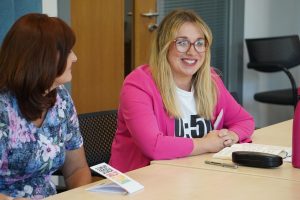
Women in the 50:50 network spoke about their own journeys in politics – both the positive experiences and the challenges that they have faced. Samara Barnes spoke about the challenge of juggling childcare but how male counterparts were never asked about this part of the job and she also highlighted that having a female- led council had meant she had received the support and resources that she needed to fulfil both roles. Erin Parker Leonard spoke about how she was still inputting on Baby Leave policy whilst she was on Baby Leave herself. Laura Blumenthal spoke about tangible changes we could make regarding safety of candidates and also managing employers when working people are campaigning. Nanda Manley-Browne spoke about being highly trained but perhaps not being able to implement that training once back in the field as things are not moving on to keep pace – and old networks are very much still in play. Elizabeth Cameron spoke about the Amplifying Muted Voices project and how there can still be an uphill battle when it comes to being a woman trying to get involved in politics, particularly when intersecting characteristics such as race and disability, as well as parenthood, are involved. Frances Lasok spoke of initiatives that were working in her area – particularly with engaging women from diverse backgrounds. Finally, Maureen Levy made a strong closing point about the impact of politics and public life on families – and that it is not just parents of young children that are affected – it can affect everyone.
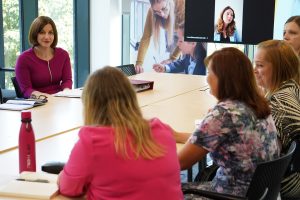
The 50:50 group made a strong case for why women should be involved at all levels in politics but that the landscape needs to change to make this sustainable and sustained. If we improve the political arena for women – all will benefit. First, we need to make it accessible in the first place as it was acknowledged in the room that there can be gate-keeping right back before selection level and we need to be working from all angles to ensure women’s equal representation – and then we need to ensure that women (and men!) can thrive once in office. We will all reap the benefits of this.
The Secretary of State responded by acknowledging the significance of these experiences, noting that gender diversity in government leads to better decision-making and more equitable outcomes for all citizens.
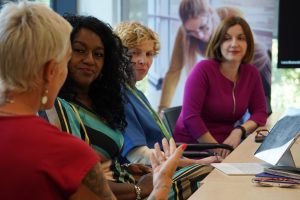
Our meeting with the Secretary of State, Bridget Phillipson, was not only enlightening but also a call to action. To remove the barriers that women face in politics, we must work together to create an environment that supports and encourages female leadership. This involves challenging gender stereotypes, providing access to resources and networks, and promoting education and advocacy. By doing so, we can ensure that women have an equal opportunity to contribute to the political landscape and that their voices are heard in the halls of power.
Thank you to the Minister for Women and Equalities – and her team – for meeting with us and giving us not only a warm welcome – but a safe and generous space to share experiences.